At King’s Liver Transplant Centre of Excellence, we understand that comprehensive care extends beyond the liver. Our expert gastroenterology team offers advanced endoscopic services to diagnose and manage various digestive system conditions.
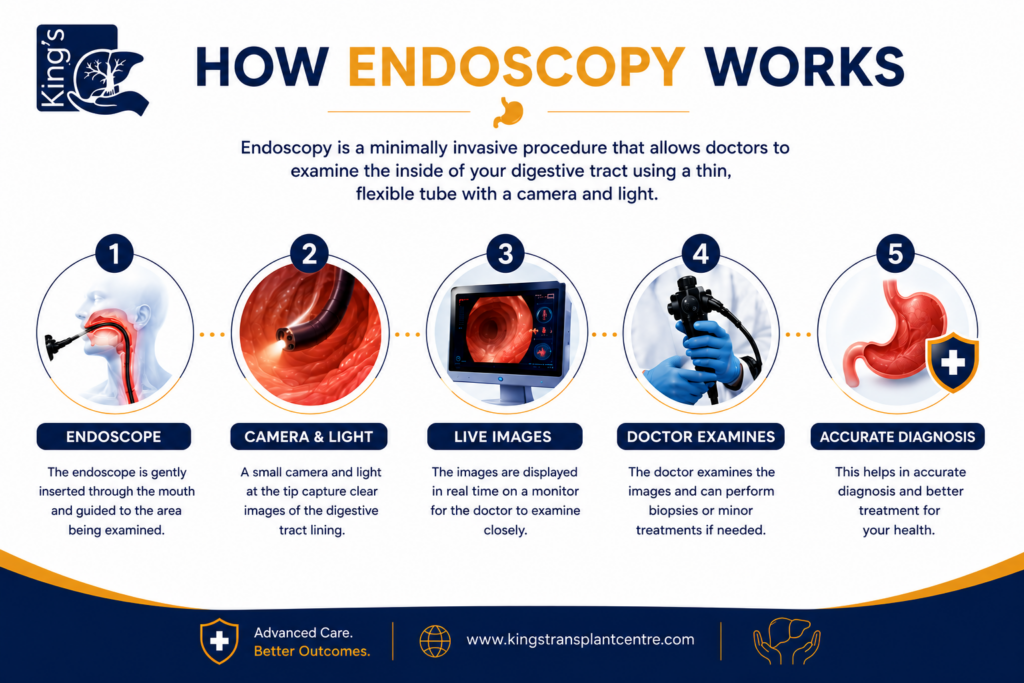
Endoscopy is a minimally invasive procedure that allows our specialists to visualise the lining of your digestive tract directly, providing crucial insights for accurate diagnosis and effective treatment planning.
What is endoscopy?
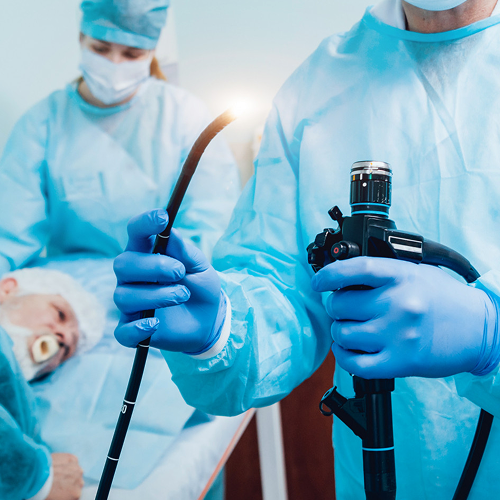
An endoscopy is performed using a slender, flexible instrument called an endoscope, equipped with a light and camera for internal viewing.
This endoscope is gently inserted into the body to visualise the internal organs. Depending on the area of concern, the endoscope can be passed through the mouth (for upper endoscopy) or the anus (for colonoscopy). This advanced technique allows our physicians to:
Visualise: Directly see the lining of the esophagus, stomach, duodenum, colon, and rectum.
Diagnose: Identify the cause of various digestive symptoms such as abdominal pain, swallowing difficulties, bleeding, and changes in bowel habits.
Biopsy: Take small tissue samples for microscopic examination to diagnose conditions like inflammation, infections, and cancer.
Treat: Perform specific therapeutic interventions, such as polyp removal, stopping bleeding, and dilating narrowings.
Our endoscopy services in Dubai
King’s Liver Transplant Centre of Excellence in Dubai offers a range of endoscopic procedures, including:
Upper endoscopy (Esophagogastroduodenoscopy – EGD): Examination of the esophagus, stomach, and the first part of the small intestine. This is often used to investigate upper abdominal pain, heartburn, and difficulty swallowing.
Colonoscopy: Examination of the entire colon and rectum. This is a vital tool for colorectal cancer screening, investigating changes in bowel habits, and identifying polyps, inflammation, and other abnormalities.
Sigmoidoscopy: Evaluation of the lower section of the colon, specifically the rectum and sigmoid colon.
Endoscopic ultrasound (EUS): This advanced technique combines endoscopy with ultrasound imaging. It allows for detailed visualisation of the layers of the digestive tract wall and adjacent organs, such as the pancreas and bile ducts, aiding in the diagnosis of complex conditions.
Our state-of-the-art endoscopy unit is equipped with the latest technology, and our experienced gastroenterologists are committed to providing safe and comfortable procedures. We prioritise patient well-being and strive for accurate and timely diagnoses.
Why choose King’s Liver Transplant Centre of Excellence for your endoscopy in Dubai?
Expert gastroenterologists: Our team comprises highly skilled and experienced gastroenterologists.
Advanced technology: We utilise cutting-edge endoscopic equipment for precise visualisation and effective interventions.
Patient-centric care: We prioritise your comfort and ensure you are well-informed.
Integrated care: Being part of King’s Liver Transplant Centre of Excellence allows for seamless care coordination if liver-related issues are also present.
Endoscopy Dubai Price
The price of endoscopy in Dubai can vary depending on the type of procedure and any additional interventions required (e.g., biopsies and polyp removal).
For specific pricing information, we recommend contacting our clinic directly. Our team will be happy to provide you with detailed information regarding the costs involved.
Take the next step for your digestive health
If you are experiencing digestive symptoms or have been advised to undergo an endoscopy, King’s Liver Transplant Centre of Excellence in Dubai is here to provide exceptional care. You’ll be guided through the entire process by our attentive team, with your well-being always at the forefront. Contact us today to schedule your endoscopy.
Frequently Asked Questions (FAQ)
The preparation varies depending on the type of endoscopy. For an upper endoscopy, you must typically fast for several hours beforehand. A bowel preparation to clear the colon is usually required for a colonoscopy. We’ll make sure you have all the detailed information you need from our team.
Most endoscopic procedures are well-tolerated. We often administer sedation to ensure your comfort throughout the examination. You might feel some pressure or bloating, but significant pain is uncommon.
The duration can vary. An upper endoscopy usually takes 15 to 30 minutes, while a colonoscopy may take 30 to 60 minutes.
Endoscopy is generally a safe procedure. While the procedure is generally safe, rare risks may still be present.
These can include bleeding, perforation (a tear in the lining of the digestive tract), and reactions to sedation. You will have the opportunity to discuss any associated risks with your doctor beforehand.
The gastroenterologist can often discuss the initial findings with you immediately after the procedure. If biopsies are taken, the results will typically be available within a few days. We will ensure you receive your results promptly.
An endoscopy can help diagnose a wide range of digestive problems by allowing the doctor to look directly inside the oesophagus, stomach, and upper part of the small intestine.
Common conditions that may be diagnosed include:
- Acid reflux and gastroesophageal reflux disease (GERD)
- Stomach ulcers
- Gastritis and inflammation of the stomach lining
- Difficulty swallowing or narrowing of the oesophagus
- Polyps or growths
- Coeliac disease
- Internal bleeding
- Infections such as Helicobacter pylori (H. pylori)
- Early signs of stomach, oesophageal, or upper digestive tract cancers
- Enlarged veins in the food pipe (varices), which can happen in people with liver disease
At Kings Transplant Centre, endoscopy is often used as an important part of diagnosing liver and digestive conditions, especially in patients who may later need specialised care such as Liver Cancer Treatment in Dubai.
Yes, most of the patients are required to fast, avoiding food and drink for 6-8 hours beforehand. An empty stomach makes it easier for the doctor to see clearly and lowers the risk of vomiting or choking during the test.
You may usually drink small sips of water up to a few hours before the procedure, but your doctor will give you exact instructions based on the type of endoscopy you are having.
If you take medicines for blood pressure, diabetes, blood thinning, or heart problems, ask your doctor whether they should be taken on the day of the procedure.
Yes. Certain gallstones and bile duct problems can be treated using a specialised type of endoscopy called ERCP (Endoscopic Retrograde Cholangiopancreatography).
During ERCP, a thin flexible tube is passed through the mouth into the digestive tract. The doctor can then reach the bile duct, remove stones, place a stent, or treat a blockage.
This is commonly used when a gallstone becomes stuck in the bile duct and causes pain, jaundice, or infection. In many cases, ERCP can treat the problem without the need for open surgery.
Yes. Endoscopy is one of the most accurate ways to diagnose stomach ulcers and ulcers in the first part of the small intestine.
The doctor can see:
- The exact location of the ulcer
- Whether it is bleeding
- Whether there is inflammation around it
- Whether a biopsy is needed to rule out more serious causes
Sometimes a small tissue sample is also taken to check for H. pylori infection, which is a common cause of ulcers.
Yes. Endoscopy can show signs of acid reflux or GERD, especially if the condition has caused irritation or damage to the lining of the oesophagus.
The test may show:
- Inflammation or redness in the food pipe
- Ulcers caused by acid reflux
- Narrowing or scarring of the oesophagus
- Changes known as Barrett’s oesophagus, which may develop after long-term reflux
However, some people with GERD may still have a normal-looking endoscopy. In these cases, the doctor may recommend other tests if symptoms continue.
Endoscopy is generally very safe, and serious complications are uncommon. Most people go home the same day and recover quickly.
Common temporary side effects include:
- Mild sore throat
- Bloating or gas
- Mild cramping
- Sleepiness from the sedative
Rare but more serious risks include:
- Bleeding may occur, especially if a biopsy or polyp removal is performed
- Infection
- Reaction to sedation
- A small tear in the digestive tract
The risk is usually very low, particularly when the procedure is performed by an expert and experienced specialist. At Kings Transplant Centre, patient safety and comfort are carefully monitored throughout the procedure.
If the doctor sees anything unusual, they may take a biopsy, which is a tiny sample of tissue. This does not usually cause pain.
Depending on what is found, the doctor may:
- Remove a polyp
- Stop bleeding
- Stretch a narrowed area
- Treat a blocked bile duct
- Arrange further scans or tests
Most abnormalities are not cancer. Many findings, such as inflammation, ulcers, or polyps, can be treated successfully when discovered early.
If there is concern about something more serious, your doctor will explain the next steps clearly and support you through the process.
After a simple endoscopy, most people can return to their normal diet within a few hours.
It is usually best to:
- Start with light foods such as soup, toast, rice, or yogurt
- Avoid very spicy, greasy, or heavy meals on the same day
- Drink plenty of water
- Avoid alcohol for at least 24 hours if sedation was used
If you had a biopsy, polyp removal, or another treatment during the endoscopy, your doctor may advise avoiding certain foods or medicines for a short time.
Blood-thinning medicines may need to be restarted carefully, depending on what was done during the procedure.
Endoscopy is considered one of the most accurate tests for problems affecting the upper digestive tract.
Because the doctor can see the lining directly and take biopsies if needed, endoscopy is often more accurate than an X-ray or scan for diagnosing ulcers, reflux, bleeding, inflammation, and many early cancers.
No test is perfect, but when performed by an experienced specialist, endoscopy provides very reliable results and can often detect problems at an early stage when treatment is easier.
Making the right choice of doctor and hospital can make a big difference to both comfort and accuracy.
Look for:
- A gastroenterologist or liver specialist with experience in endoscopy
- A hospital that performs a large number of endoscopy procedures
- Access to advanced tests such as ERCP and endoscopic ultrasound
- A team that can provide follow-up treatment if something is found
- Clear communication and good patient support
For people with liver disease, jaundice, bile duct problems, or concern about liver tumours, it is important to choose a centre with both digestive and liver expertise. Patients looking for the Best Liver Doctor in Dubai often choose Kings Transplant Centre because it combines advanced endoscopy services with specialised liver care and Liver Cancer Treatment in Dubai.
The need for repeat endoscopy depends on the condition being treated.
- GERD or acid reflux: repeat endoscopy may only be needed if symptoms continue, worsen, or if there is Barrett’s oesophagus
- Stomach ulcers: a repeat endoscopy is sometimes recommended after treatment to make sure the ulcer has healed
- Liver disease or varices: patients with cirrhosis may need regular endoscopy every 1 to 3 years to check for enlarged veins in the oesophagus
- Barrett’s oesophagus: follow-up endoscopy may be needed every few years depending on the findings
Your doctor will plan a schedule based on your symptoms, risk factors, and overall health.