
Deceased Donor Kidney Transplant in Dubqai
Deceased Donor Kidney Transplant In Dubai

- Home
- Kidney Transplant Services
- Deceased Donor Kidney Transplant
Deceased donor kidney transplant in Dubai offers hope to patients living with advanced kidney failure. At King’s Transplant Centre, patients receive structured evaluation, surgical expertise, and coordinated pre and post-transplant care under the expert supervision of internationally trained specialists within a UK-standard clinical framework in Dubai.
When kidneys fail permanently, dialysis can sustain life, but transplantation often provides better long-term survival, improved energy levels, and greater dietary flexibility. A deceased donor kidney transplant involves placing a healthy kidney from a recently deceased donor into a recipient whose kidneys no longer function adequately.
What is a Deceased Donor Kidney Transplant?
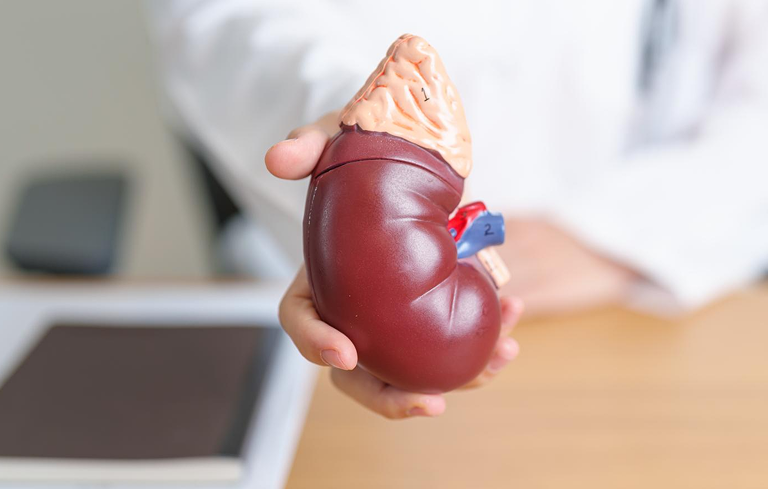
A deceased donor kidney transplant is a surgical procedure where a healthy kidney from a recently deceased person is transplanted into a patient with end-stage kidney disease.
The donor kidney is carefully assessed and preserved under controlled conditions. It is then allocated to the patient through a regulated organ procurement network.
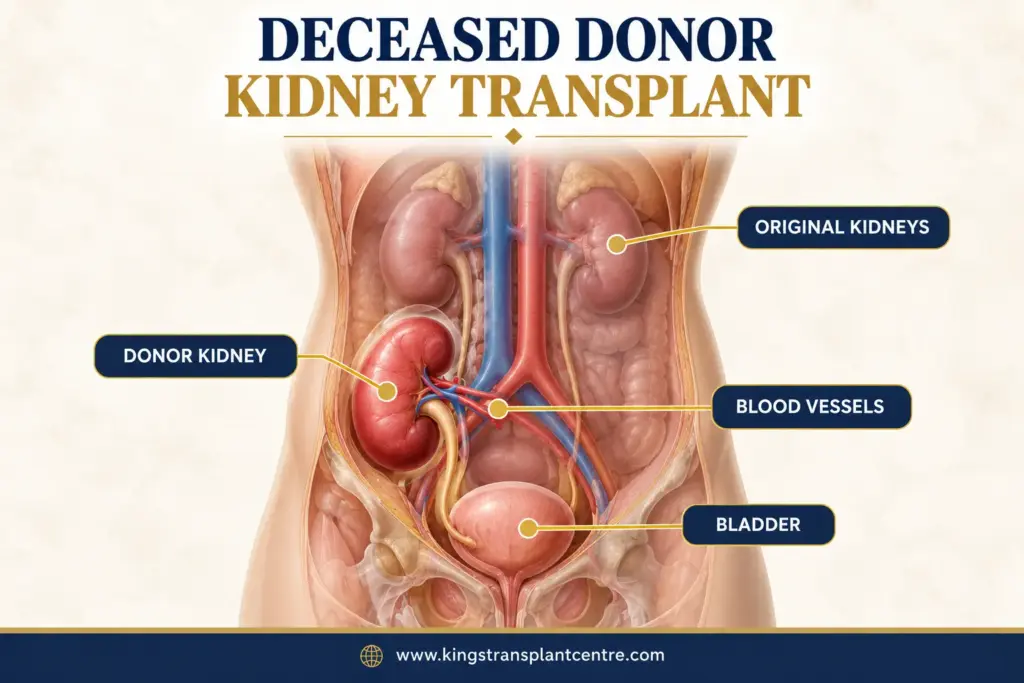
One healthy kidney is required to meet the body’s excretory needs. During surgery, the donated kidney is placed in the lower abdomen and connected with the blood vessels and the bladder. The patient’s original kidneys are usually left in place unless medically indicated otherwise.
Who qualifies for transplantation?
Transplant is considered for patients with:
- End-stage kidney disease
- Irreversible chronic kidney disease
- Dialysis dependence
- Severe reduction in kidney function with complications
Each patient undergoes a Detailed medical evaluation that includes physical examination, imaging, blood tests, cardiac assessment, cancer screening, and psychosocial review. The goal is mainly to confirm that surgery is safe and that the patient can manage lifelong follow-up care.
Organ donation and allocation
A person who has died is one who agreed in life to donate an organ or whose family gives their approval after they have died. Organs are only removed when rigorous medical and ethical criteria are fulfilled. In the case of organ donation, there is a time limit after death during which the kidneys must be removed quickly in order to keep them viable. When circulation ceases, the transplant team acts within a specified preservation period and cools the kidney or puts it on a preservation machine to ensure that it continues to receive oxygen and nutrients until it is transplanted.
Allocation is done based on factors like:
- Blood type compatibility
- Tissue matching
- Medical urgency and waiting time
- Geographic proximity
Organ donation time limit after death is medically defined to preserve organ function.
King’s Transplant Centre works with regulated transplant networks to ensure ethical and transparent allocation practices are adhered.
How long does a deceased donor kidney last?
Many patients ask, ‘’How long does a deceased donor kidney last?’’ On average, a deceased donor kidney transplant in dubai functions for approximately 10 to 15 years. However, it can vary depending on:
- Donor quality
- Recipient health
- Immune response
- Medication adherence
- Lifestyle habits
When comparing how long does a donor kidney lasts in general, kidneys from living donors tend to function longer, often 15 to 20 years. Still, deceased donor transplantation remains a life-saving and effective treatment option.
Patients also ask about the ‘’maximum life expectancy after kidney transplant’’. With good graft function and consistent follow-up, many recipients live decades after transplantation, returning to work, family life, and normal activity.
Kidney Transplant Services
Meet Our kidney specialists in Dubai


Understanding expanded criteria donors
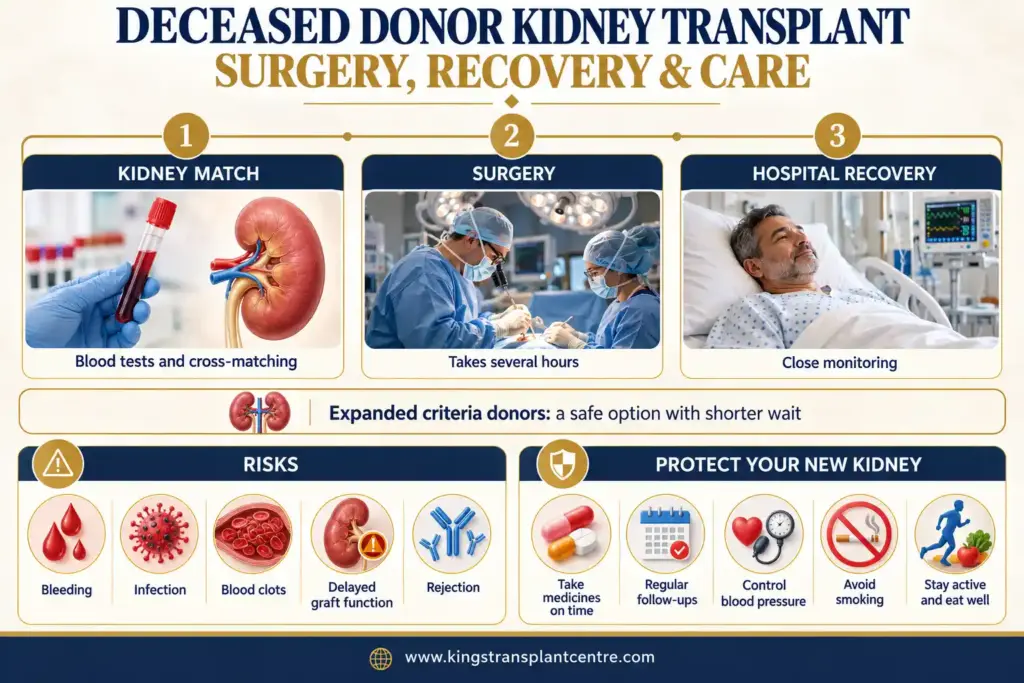
Not all kidneys given as donations are obtained from young and healthy individuals; in some instances the donors are older or have certain medical conditions which are well controlled. Even though kidneys from such donors become available more quickly, they can still provide a significant advantage in terms of survival when compared to continuing on dialysis or waiting on the list.
In some cases it is possible to transplant both kidneys from these donors at the same time in order to enhance the overall function. Each case is considered on its own with the transplant team to make sure that informed decisions are reached.
The surgical process
When a suitable donor kidney is available, the transplant team contacts the patient. Further blood tests and cross-matching are then carried out at the hospital to check compatibility before surgery.
The operation generally takes several hours, and patients remain in hospital afterwards so the medical team can monitor their recovery. The new kidney may begin working straight away, although some patients need temporary dialysis until it functions adequately.
Risks and recovery
As with any major surgery, risks include:
- Bleeding
- Infection
- Blood clots
- Delayed graft function
- Rejection
Organ rejection happens due to the immune system attacks the transplanted kidney. To prevent this, patients take immunosuppressive medications daily. These medications require lifelong adherence and monitoring.
Recovery phase includes strict adherence to:
- Blood tests: Get tested regularly to see how well your kidney is working.
- Medication: Make changes to your doses only as advised by your transplant team.
- Blood pressure: Check your readings and work with your care team to keep them under control.
- Infection prevention: Practise good hygiene and let your medical team know if you notice signs of infection.
- Nutrition: Choose a balanced diet that supports your recovery and overall health.
King’s Transplant Centre provides coordinated follow-up care involving transplant surgeons, nephrologists, ICU specialists, nurses, dietitians, and transplant coordinators.
How patients can protect their new kidney
Long-term success depends heavily on patient involvement. To help the kidneys last longer:
- Medications: Take your medicines on time and follow your prescribed schedule.
- Follow-ups: Keep your appointments so your team can check how well your kidney is working.
- Blood pressure: Check your blood pressure regularly and follow your care team’s advice.
- Diabetes: If you have diabetes, work to keep your blood sugar within the recommended range.
- Smoking: Avoid smoking to help protect your heart and kidneys.
- Physical activity: Choose activities that fit your recovery and your care team’s recommendations.
- Infections: Consult your medical team if you notice signs of infection, rather than waiting for symptoms to worsen.
They play a major role in determining how long does a donor kidney lasts in each case.
Why choose King’s Transplant Centre
King’s Transplant Centre delivers UK-standard transplant care in Dubai with:
- Multidisciplinary expertise: Specialists work together to plan and manage kidney transplant care.
- Surgical and ICU facilities: Dedicated facilities support the procedure and recovery after surgery.
- Pre-transplant assessment: Medical tests help establish whether a transplant is an appropriate option.
- Dedicated coordinators: Patients receive help arranging investigations, appointments and treatment.
- Ethical organ allocation: Transplant decisions are guided by established medical and ethical standards.
- International patient support: Overseas patients can access assistance with care arrangements.
- Research-led practice: Treatment approaches are informed by current medical evidence and research.
The centre operates as per the comprehensive and regulated transplant environment. It also offers diagnostics, critical care, and long-term monitoring under one roof.
A second chance at life
A deceased donor kidney transplant in Dubai is not a simply a surgical procedure. Kidney transplantation begins with a thorough medical assessment, followed by surgery and lifelong monitoring. For people with kidney failure, a successful transplant may offer a longer life, improved day-to-day well-being and freedom from regular dialysis.
If you or your loved one is seeking a deceased donor kidney transplant in Dubai, the team at King’s Transplant Centre is ready to guide you through evaluation, eligibility, and treatment planning with clarity and clinical precision.
Book an appointment today to begin your transplant assessment and take the next step toward restoring your kidney health.
Deceased Donor Kidney Transplant in Dubai FAQs
What is a deceased donor?
A deceased donor is someone who has died and whose organs or tissues are donated for transplantation, with appropriate consent and in accordance with applicable laws.
What can a deceased donor donate?
Depending on medical suitability, a deceased donor may donate organs such as the kidneys, liver, heart, lungs and pancreas. Tissues such as corneas, skin, bone and heart valves may also be donated.
What is the difference between a living donor and a deceased donor?
A living donor gives an organ, usually a kidney, during their lifetime. A deceased donor donates organs after death, with suitable recipients identified based on medical compatibility and organ allocation criteria.
Can you get a kidney from a deceased donor?
Yes. A kidney taken from a deceased donor can be transplanted into a suitable recipient who has kidney failure, and compatibility, medical suitability and organ allocation criteria are used to decide who receives the kidney.
How long does it take for a deceased donor kidney to start working?
A deceased donor kidney may start working immediately or within a few days. Sometimes, it takes longer to function properly, and temporary dialysis may be needed while the kidney recovers.
How painful is kidney donation surgery?
The surgery for giving a kidney is carried out with the patient under general anaesthesia and so they do not experience any pain during the procedure. It is usual to feel sore and uncomfortable when recovering and this discomfort is treated with pain relief. The length of recovery differs from person to person and depending on the surgical method.
Does life change after donating a kidney?
After giving away a kidney, the majority of people are able to go back to their usual routines and can lead healthy lives with just one kidney. It is still important to have regular medical check-ups in order to keep an eye on kidney function and to ensure long-term health.
What is the average wait time for a deceased donor kidney?
Waiting times vary by country, transplant centre, blood group, tissue compatibility and organ availability. In some places, patients may wait several years. The transplant team can provide guidance based on local waiting lists and individual circumstances.
What is the average lifespan of a donor kidney?
A transplanted kidney from a deceased donor often functions for around 10–15 years, although some last considerably longer or less time. The outcome depends on factors such as donor kidney quality, recipient health, medication adherence and post-transplant care.