

Stage 4 Kidney Failure Life Expectancy Without Dialysis: What to Know

Your doctor says your kidneys are at stage 4, and suddenly, everything feels urgent.
- How long do I have?
- Will I need dialysis?
- Is there a way around it?
These are fair questions, and the answers are often more hopeful than people expect.
This guide explains what is stage 4 kidney failure, how long you can live with stage 4 kidney disease, and what stage 4 kidney failure life expectancy without dialysis looks like according to published research. Read more about conservative kidney management, a kidney transplant before dialysis (called a preemptive transplant) and when to ask for specialist help.
King’s Transplant Centre in Dubai, a legacy of King’s College Hospital London, works with patients at exactly this stage. Their view is simple: stage 4 is not the end of the road. It is the best time to make a plan.
What is stage 4 Kidney Failure (CKD stage 4)?
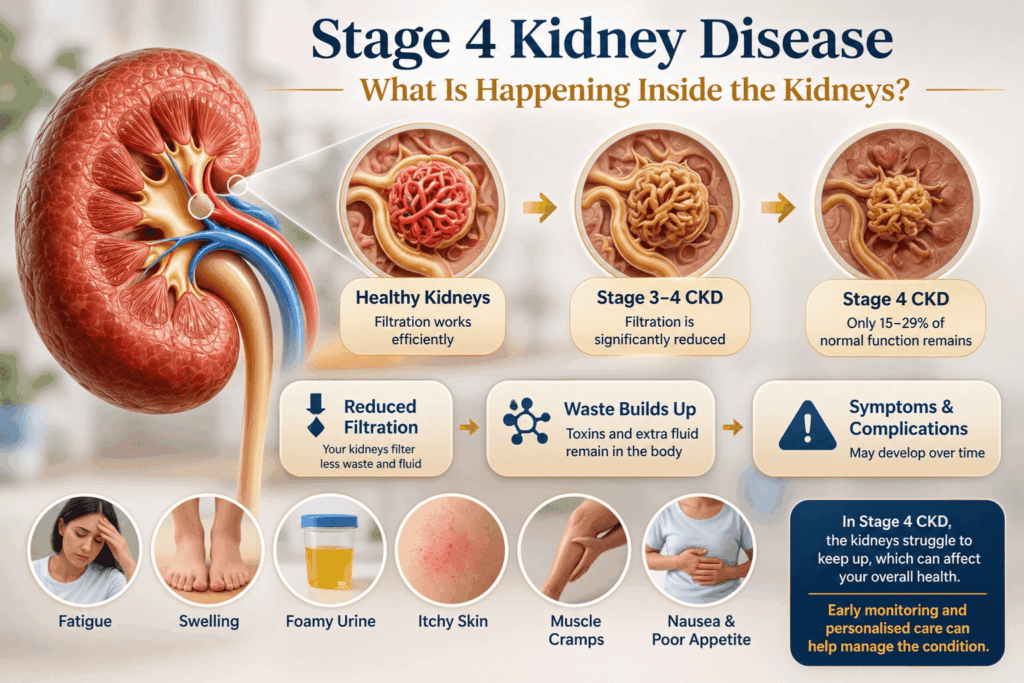
Chronic kidney disease (CKD) is divided into five stages based on your eGFR (estimated glomerular filtration rate), a value that indicates how well your kidneys filter blood. Stage 4 means an eGFR of 15 to 29, so your kidneys are working at roughly 15% to 30% of normal. That is serious, but it is not yet kidney failure in the strict medical sense. That label belongs to stage 5.
Quick snapshot:
- Stage 3b: eGFR 30 to 44, moderate loss of function
- Stage 4: eGFR 15 to 29, severe loss of function, time to plan
- Stage 5: eGFR below 15, kidney failure, when dialysis or a transplant is usually needed
Did you know? Global studies suggest that about 1 in 10 adults has some level of kidney disease, and many do not know it because the early stages are so quiet. |
What is the creatinine level for stage 4 kidney disease?
There is no single cutoff. Creatinine is a waste product in your blood, and doctors combine it with your age, sex and body size to calculate eGFR.
The eGFR, not creatinine alone, sets your stage.
In many adults, the creatinine level for stage 4 kidney disease typically falls between 2 and 4.5 mg/dL (about 180 to 400 µmol/L), but two people with the same creatinine level can end up in different stages. Ask your nephrologist for your eGFR trend over time, not just one result.
Stage 4 kidney disease symptoms: What your body may be telling you
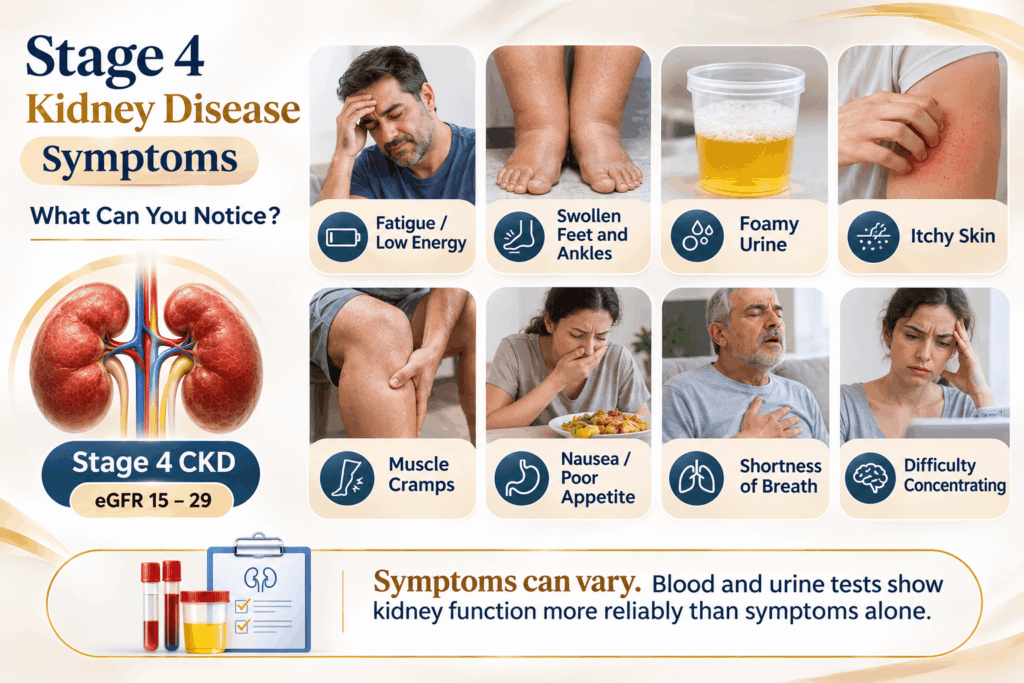
Kidneys stay quiet for a long time. By stage 4, symptoms often start to build, though they are easy to blame on stress or aging:
- Constant tiredness and low energy
- Swelling in the feet, ankles, hands or face
- Foamy urine, or getting up at night to urinate
- Itchy, dry skin and muscle cramps
- Poor appetite, nausea or a metallic taste in the mouth
- Shortness of breath or trouble concentrating
Stage 4 kidney disease symptoms are not specific to the kidneys, so blood and urine tests, not symptoms alone, show where you really stand.
How long can you live with stage 4 kidney disease?
No honest article can give you one number. Your outlook depends on:
How fast your eGFR is falling – A steady number can stay steady for years. | The cause – such as diabetes, high blood pressure or glomerulonephritis. | Heart health is a concern because heart disease is a major risk at this stage. | Your age and other health conditions. |
Many people live for years in stage 4, especially when blood pressure and blood sugar are well controlled. The goal is to slow the decline and be ready if it continues.
Stage 4 kidney failure life expectancy without dialysis: What the research shows
Two different situations often get mixed up here:
- Stage 4, not yet on dialysis. You are not going without treatment. Your kidneys still do a lot of work, and most people at this point do not need dialysis yet.
- Stage 5, choosing not to start dialysis. Studies of older adults managed without dialysis report median survival ranging from 1 to 45 months, with 1-year survival between 29% and 82%. That wide gap reflects age, other illnesses and day-to-day function.
Research also shows that in people 80 or older with several other conditions and poor functional status, dialysis may not extend life. For younger, fitter patients, it usually does. That is why this decision has to be personal, never generic.
Does stage 4 kidney disease need dialysis?
Stage 4 CKD does not usually require dialysis immediately. Dialysis may become necessary as kidney function declines, particularly when symptoms, fluid overload or blood chemistry abnormalities cannot be adequately managed with other treatments. The decision depends on your overall clinical condition, not eGFR alone.
This is the time to discuss future treatment options with your nephrologist.
Conservative kidney management: Care without dialysis
Conservative kidney management is a planned, active way to care for advanced kidney disease without dialysis. It is not doing nothing. It focuses on:
- Controlling blood pressure, blood sugar and cholesterol
- Managing anemia, swelling and mineral balance
- A kidney-friendly diet built with a renal dietitian
- Relieving itching, nausea and fatigue
- Advance care planning with your family
For some people, especially older adults with other serious conditions, conservative kidney management can offer the quality of life they want. You can also change course later.
Stage 4 kidney disease can it be reversed?
Stage 4 CKD is not usually reversible when permanent kidney damage has occurred. However, addressing underlying problems, managing blood pressure and blood sugar, and avoiding medications that may harm the kidneys can help slow further decline. The likely benefit depends on the underlying cause and the extent of existing damage.
Kidney transplant before dialysis: Can you skip dialysis?
Yes, for the right patients. A transplant done before dialysis ever starts is called a preemptive transplant. It is associated with a lower risk of rejection, longer life, better quality of life, and lower treatment costs, and it spares you the dietary restrictions and complications of dialysis. Yet in the US, only about 2.5% of kidney transplants are preemptive, mostly because of donor shortages, late referrals and delays in evaluating living donors
The takeaway for anyone in stage 4: ask about a kidney transplant before dialysis now, while your kidneys still work.
- Early evaluation. Transplant evaluation is generally recommended once eGFR drops below 30.
- Living donor testing. Willing family members can be tested while you are still well, which can shorten the wait.
- Honest trade-offs. Surgery comes sooner, and anti-rejection medicines are lifelong.
FAQs
You cannot prevent every case, but you can lower your risk a lot. Keep blood pressure and blood sugar in your target range, cut back on salt, avoid regular NSAID use, do not smoke and stay active. If you have diabetes, high blood pressure, heart disease or a family history of kidney disease, get a blood test and a urine test once a year.
Many people feel worn out, nauseated and itchy, with swelling, shortness of breath, cramps and trouble sleeping. Some notice a metallic taste, foggy thinking or less urine. Early kidney disease often feels like nothing, so do not wait for symptoms to get tested.
It can contribute. Heavy or binge drinking can trigger sudden kidney injury, raises blood pressure and, over time, can damage the liver, which puts extra strain on the kidneys. If you already have stage 4 CKD, ask your nephrologist what is safe for you.
- Treatment slows the damage and prepares you for what comes next. That usually means blood pressure and diabetes control, a kidney-friendly diet, treatment for anemia and bone-mineral problems, and avoiding drugs that harm the kidneys. You and your care team also look at the next step: a preemptive transplant, dialysis or conservative kidney management.
There is no fixed timeline. Some people stay in stage 4 for many years, while others progress within months. A sustained eGFR drop of more than 5 points a year is considered rapid progression. The cause of your kidney disease, blood pressure, blood sugar and protein in the urine all play a role.
How long someone can live without dialysis depends on their remaining kidney function, symptoms, overall health and whether dangerous complications develop. If dialysis has been recommended, do not delay or stop treatment without speaking to your nephrologist. Severe breathlessness, confusion or other signs of a serious complication require urgent medical assessment.
Waste, fluid and potassium build up in the body. This can cause fluid in the lungs, severe breathlessness, dangerous heart rhythms, nausea, confusion and drowsiness, and it can become life-threatening. If you have these symptoms, seek urgent medical care.
Overview
Why plan your next step at King's Transplant Centre
A preemptive transplant works best when everything is under one roof. King’s Transplant Centre offers the following benefits:
| Living donor kidney transplants, and it reports being the only center in Dubai offering this surgery, with paired kidney exchange and donation from relatives up to the fourth degree, supported under UAE law | Full-time transplant specialists who stay with you from evaluation to recovery | Donor safety as the top priority, with robotic living donor surgery in development | Dialysis care, including hemodialysis and peritoneal dialysis, if that turns out to be the right path | An international patient coordinator for scheduling, visas and airport transfers |
A typical kidney transplant hospital stay is 5 to 7 days, and donors usually return to normal activities within 4 to 6 weeks.
Stage 4 is your window to plan: Talk to King’s Transplant Centre early
Stage 4 does not mean dialysis is coming tomorrow. It means you have time to understand your numbers, compare conservative care, dialysis and a transplant, and choose what fits your life.
The earlier you ask, the more options you keep. Book an appointment with King’s Transplant Centre in Dubai today.