

What size of Kidney Cyst is dangerous? A complete guide

What size of Kidney Cyst is dangerous? Understand cyst sizes, risks, and warning signs
Suppose that one of your regular ultrasounds finds a cyst 50 mm in size in your kidney? Do you feel concerned?
Does its size imply that it is something serious, or is it something that can be ignored.
The good news is that the majority of kidney cysts are harmless. But their size, internal structure and impact on kidney function need to be carefully evaluated.
King’s Transplant Centre of Excellence offers a range of specialist nephrology services, cutting-edge kidney imaging and multidisciplinary expertise in complex kidney diseases and transplantation.
This guide explains what size of kidney cyst is dangerous, how doctors assess cysts, which symptoms require attention, and when treatment may be necessary.
What is a Kidney Cyst?
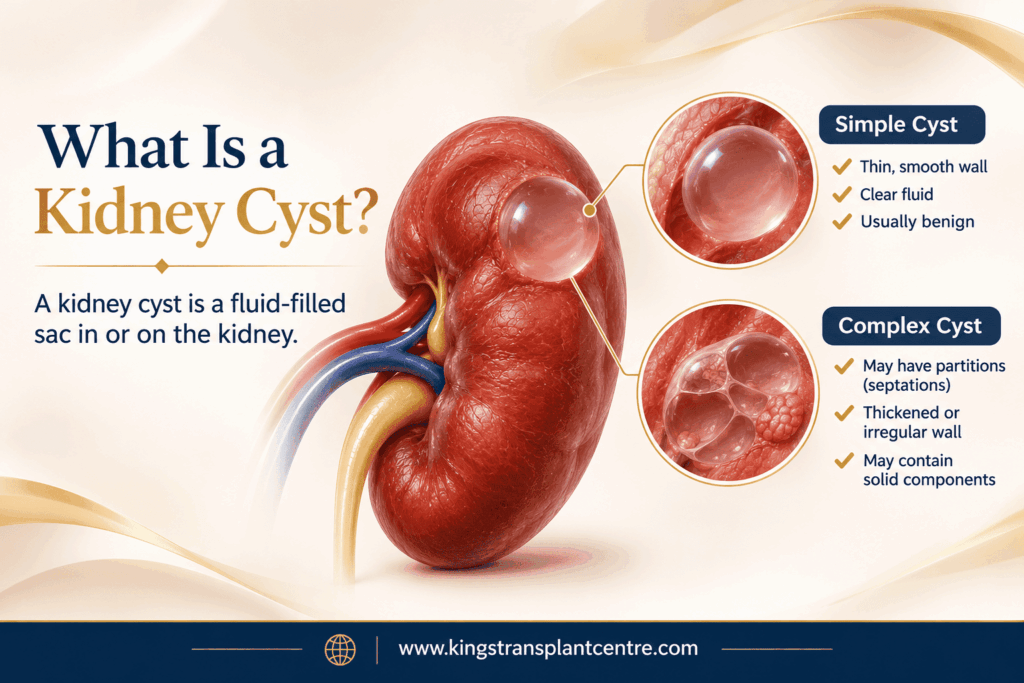
A kidney cyst is a rounded, fluid-filled sac that develops within the kidney or on its surface. Some measure only a few millimeters, while others grow several centimeters across.
There are two types, typically recognized by doctors.
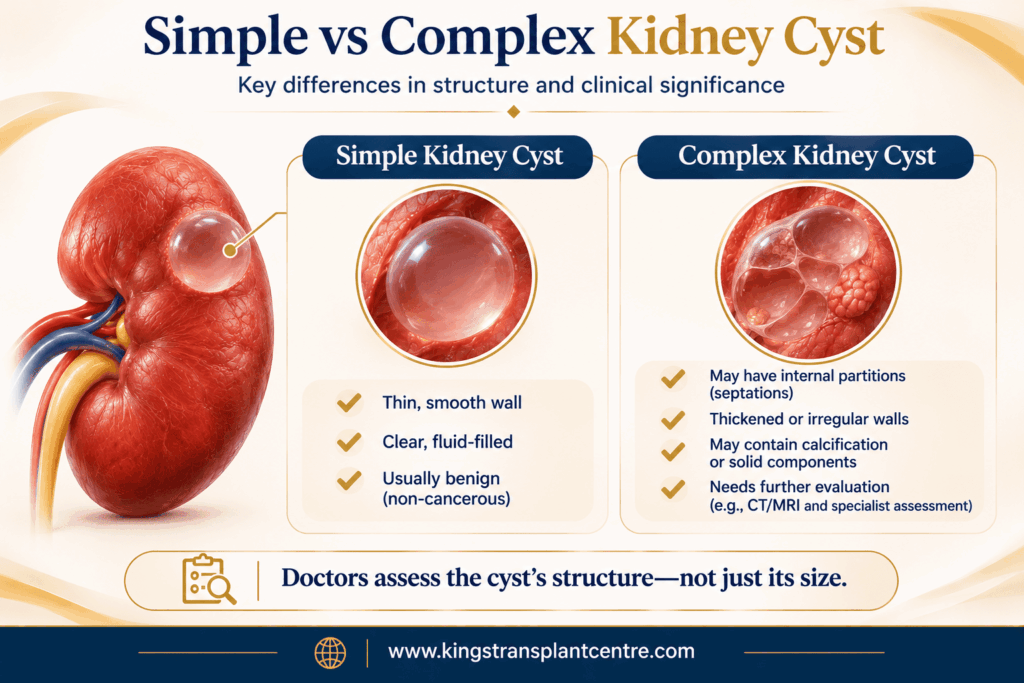
- Simple kidney cyst: Contains clear fluid and has a thin, smooth wall. It tends to be non-cancerous.
- Complex kidney cyst: This may have additional partitions, thickened walls, calcifications or solid tissue within the cyst. Additional imaging might be necessary to determine the risk of cancer.
A cortical cyst in kidney tissue develops in the outer region, called the renal cortex. Its location alone does not make it dangerous.
What size of Kidney Cyst is dangerous in mm?
There is no fixed measurement at which a kidney cyst becomes dangerous.
Large cysts (those over 50 mm or 5 cm) should be evaluated, especially if painful or impeding urine flow. Even a bigger simple cyst can be harmless, though.
On the other hand, if a small complex cyst is found, it may need further evaluation due to typical imaging characteristics.
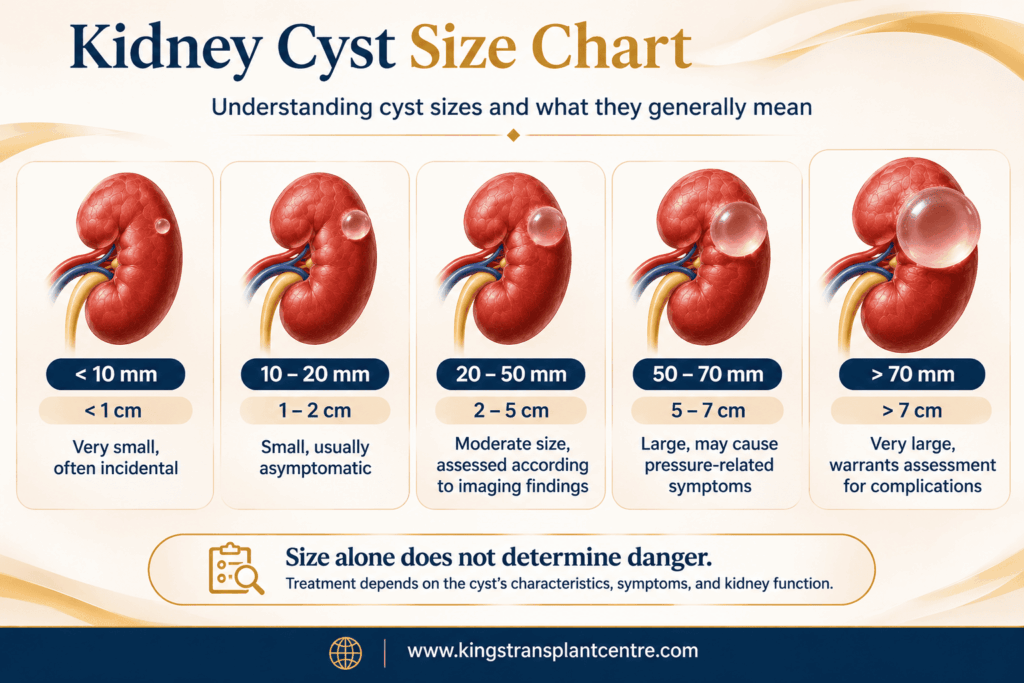
Kidney Cyst size chart: Understanding the measurements
Cyst size (mm) | Size (cm) | General interpretation |
Under 10 mm | Under 1 cm | Very small, often incidental |
10–20 mm | 1–2 cm | Small, usually asymptomatic |
20–50 mm | 2–5 cm | Moderate size, assessed according to imaging findings |
50–70 mm | 5–7 cm | Large, may cause pressure-related symptoms |
Over 70 mm | Over 7 cm | Very large, warrants assessment for complications |
These are descriptive size ranges, not standardized danger thresholds. Treatment depends on cyst characteristics, symptoms, and kidney function.
Did you know? A 70 mm simple cyst may be less concerning than a 20 mm cyst with suspicious solid components. Radiologists therefore examine the cyst’s structure rather than relying on diameter alone. |
What causes a Kidney Cyst?
The precise answer to what causes a kidney cyst remains unclear.
Simple cysts may develop when microscopic kidney tubules become dilated and collect fluid. They become more common with advancing age.
Additional complications associated with kidney cysts are:
- Polycystic kidney disease (PKD), a hereditary condition that causes many cysts
- Some genetic disorders of the kidneys’ development
- Chronic kidney disease (CKD), is a condition that affects the kidneys, especially if the patient is on long-term dialysis.
Kidney Cyst symptoms: When should you be concerned?
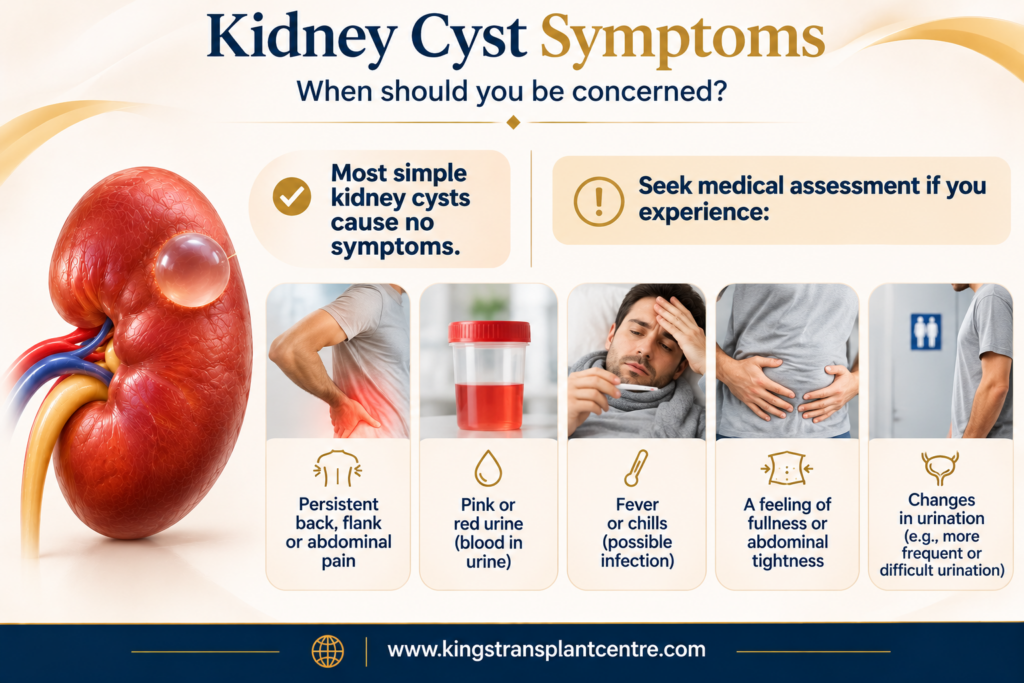
Most simple cysts produce no noticeable symptoms. Problems generally arise when a cyst becomes infected, bleeds, ruptures, or compresses nearby structures.
The signs and symptoms of kidney cyst may be:
- Chronic back, abdominal or flank pain
- Pink or red urine
- Sick feeling along with fever or chills
- Abdomen feels full or tight
- Changes in urination pattern
If pain is sudden and severe or there is blood in the urine reach to the doctor urgently.
How do doctors determine whether a Kidney Cyst is dangerous?
The first step is usually an ultrasound. If the cyst on kidney imaging appears unusual, doctors may recommend contrast-enhanced CT or MRI.
The Bosniak classification helps assess cystic kidney masses according to their imaging features.
Bosniak category | General findings | Usual approach |
I | Simple, thin-walled cyst | No routine follow-up |
II | Minimally complex, benign features | Usually no follow-up |
IIF | More complex features requiring observation | Scheduled imaging |
III | Indeterminate, potentially malignant | Specialist assessment |
IV | Features strongly suggesting malignancy | Specialist evaluation and treatment planning
|
Bosniak III and IV lesions require individualized decisions. Depending on their size, imaging findings, and patient factors, management may involve observation or intervention.
How are Kidney Cysts treated?
Treatment is guided by symptoms, kidney function, and imaging findings.
- Observation: Asymptomatic simple cysts generally need no intervention. Selected cysts may require periodic imaging.
- Aspiration and sclerotherapy: A symptomatic simple cyst may be drained using a needle, followed by a solution intended to reduce recurrence.
- Laparoscopic surgery: Large, troublesome simple cysts may occasionally require surgical treatment.
- Management of complex cysts: Suspicious lesions require specialist evaluation. Options may include surveillance, ablation, or surgery, with an emphasis on preserving healthy kidney tissue where appropriate.
Overview
Why choose King’s Transplant Centre of Excellence?
Kidney cysts rarely require transplantation. However, patients with complex kidney disorders may benefit from coordinated specialist care.
King’s Transplant Centre of Excellence Dubai offers:
- Advanced diagnostics: Kidney ultrasound, CT, and MRI for detailed evaluation
- Multidisciplinary expertise: Nephrologists and transplant surgeon, and specialist care teams
- Renal care: Evaluation and treatment of chronic kidney disease, kidney failure and polycystic kidney disease
- Living donor kidney transplantation: This is a specific service that is provided for patients who are suitable for kidney transplantation from a living donor, when they have advanced kidney failure
- Continuity of care: Comprehensive evaluation, treatment plan, and follow-up
The centre’s strategy takes into account the kidney function, nature of the underlying condition and long-term treatment requirements.
The right diagnosis for a Kidney Cyst is just a step away
An imaging report that reveals the presence of a kidney cyst can raise some challenging questions. However, being larger does not mean that a cyst is a problem. Similarly, its internal appearance, growth, symptoms and effect on kidney function are important.
At King’s Transplant Centre of Excellence, Dubai, specialist teams provide kidney disease assessment, advanced diagnostic services, and individualized care for patients with complex renal conditions.
Contact King’s Transplant Centre of Excellence to arrange a specialist consultation.