

Hemodialysis vs Peritoneal Dialysis: Differences, benefits & how to choose the right treatment

Hearing that your kidneys are no longer working as they should can feel alarming. Questions about treatment, daily life, and what lies ahead often come all at once. One of the first decisions many patients face is choosing between hemodialysis vs peritoneal dialysis. While both treatments perform the essential work of filtering waste and excess fluid from the body, they differ in how they work, where they are performed, and how they fit into everyday life.
The best choice is dependent on which one is best for you based on your health, lifestyle, and treatment plans. Dialysis is a way of life for many individuals who are undergoing advanced kidney disease, which may be a stepping stone to kidney transplantation. To some, however, it can be a long-term therapy that will enable them to continue living an active and meaningful life.
King’s Transplant Centre of Excellence, Dubai delivers kidney treatment by a team of experts from various disciplines. We educate patients about all the treatment options available to them and which ones are best for them to maintain their health and quality of life, starting from early management of chronic kidney disease through dialysis planning, kidney transplantation and lifelong follow-up.
What is Dialysis?
Dialysis is a medical treatment that replaces some of the essential functions normally carried out by healthy kidneys. When the kidneys lose most of their filtering ability due to advanced chronic kidney disease or kidney failure, waste products, excess salts, and fluid begin to build up in the bloodstream.
Without treatment, this buildup can lead to serious complications affecting the heart, lungs, brain, and other organs.
The two main types of dialysis are:
- Hemodialysis
- Peritoneal dialysis
Although both treatments aim to remove waste and maintain fluid balance, they use very different methods to achieve this.
When is Dialysis needed?
Dialysis is typically advised when the kidneys no longer perform the function of keeping the body’s fluid, electrolyte and waste levels in balance.
Doctors take into account a number of factors, such as:
- Ongoing nausea or vomiting
- Severe fatigue and weakness
- Swelling of legs or face
- Shortness of breath due to overhydration
- High potassium levels
- Metabolic acidosis
- Loss of appetite
- Very low estimated kidney function (eGFR)
- Symptoms of uremia
Your nephrologist will evaluate your overall health before deciding the right time to begin treatment.
What is Hemodialysis?
Hemodialysis removes waste products and extra fluid by circulating blood through a special machine known as a dialyzer, sometimes called an artificial kidney.
Blood leaves the body through a vascular access, passes through the machine for filtration, and is then safely returned.
Most patients receive treatment three times each week, with each session lasting approximately three to five hours, although schedules may vary depending on individual medical needs.
What is a Hemodialysis Catheter?
A hemodialysis catheter is a flexible tube placed into a large vein, usually in the neck or upper chest.
It provides immediate access for dialysis when treatment must begin urgently or while a permanent access is still developing.
Catheters are useful in emergency situations, but have a greater likelihood of infection and blood clots than permanent access. When dialysis is to be initiated for more than a month, doctors typically try to form an AV fistula as much as possible.
What is a Fistula for Dialysis?
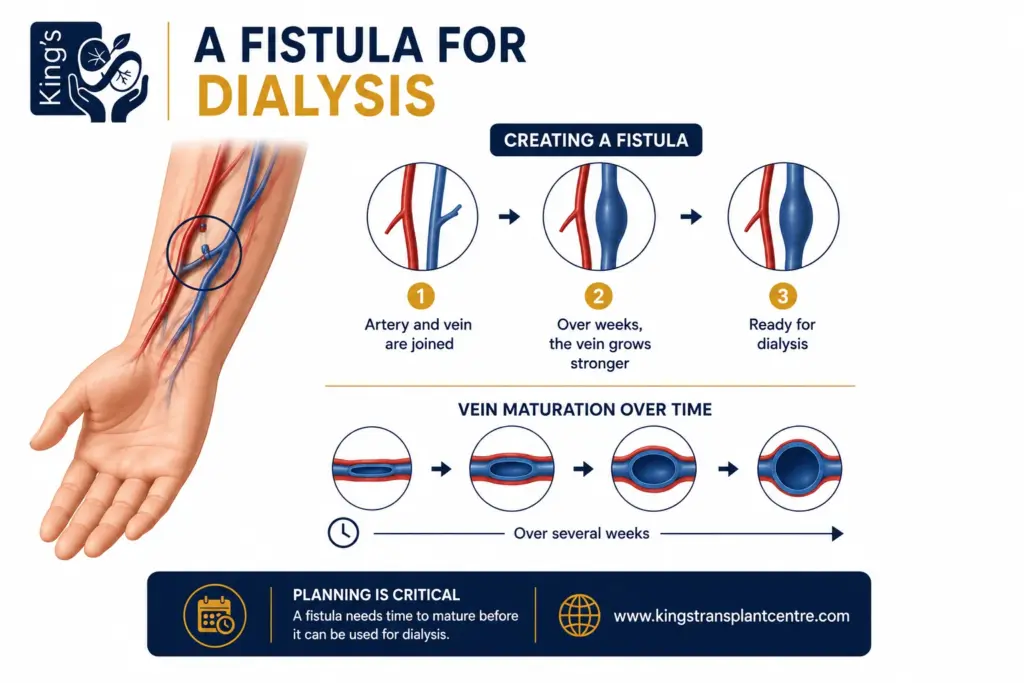
A fistula for dialysis is considered the preferred long-term vascular access for hemodialysis.
It is created through a small surgical procedure that joins an artery directly to a nearby vein, most commonly in the forearm. Over several weeks, the vein becomes larger and stronger, making it suitable for repeated dialysis treatments.
Fistulas offer the following benefits over catheters:
- Better blood flow
- Lower infection rates
- Reduced clotting risk
- Longer-lasting access
- Better dialysis efficiency
Planning is critical for patients headed towards kidney failure, as a fistula does require maturation.
Benefits of Hemodialysis
There are several benefits of hemodialysis:
- Treatment is monitored by highly qualified dialysis staff
- Specialized equipment makes for efficient waste removal
- Patients will not have to carry out daily dialysis procedures
- Medical staff monitors blood pressure and overall health during every session
- Dialysis center provide access to dietitians, nurses, and nephrologists in one location
Possible challenges of Hemodialysis
Like any treatment, hemodialysis also has limitations.
Patients may experience:
- Fatigue after treatment
- Muscle cramps
- Blood pressure changes
- Strict fluid restrictions
- Dietary limitations
- Regular travel to the dialysis center
- Time commitment several days each week
Most side effects improve as the care team adjusts the dialysis prescription to suit each patient’s needs.
What is Peritoneal Dialysis?
Peritoneal dialysis uses the body’s own abdominal lining, called the peritoneum, as a natural filter.
Instead of filtering blood through a machine, a cleansing fluid called dialysate is introduced into the abdomen through a peritoneal dialysis catheter. Waste products and excess fluid move from the bloodstream into this solution before it is drained and replaced with fresh fluid.
Because the treatment occurs gradually throughout the day or overnight, many patients appreciate the flexibility it offers.
What is a Peritoneal Dialysis Catheter?
A peritoneal dialysis catheter is a soft tube placed into the abdomen through a minor surgical procedure.
Unlike a hemodialysis catheter, it remains in place permanently while peritoneal dialysis is being used. Proper daily cleaning and catheter care are essential to reduce the risk of infection.
Types of Peritoneal Dialysis
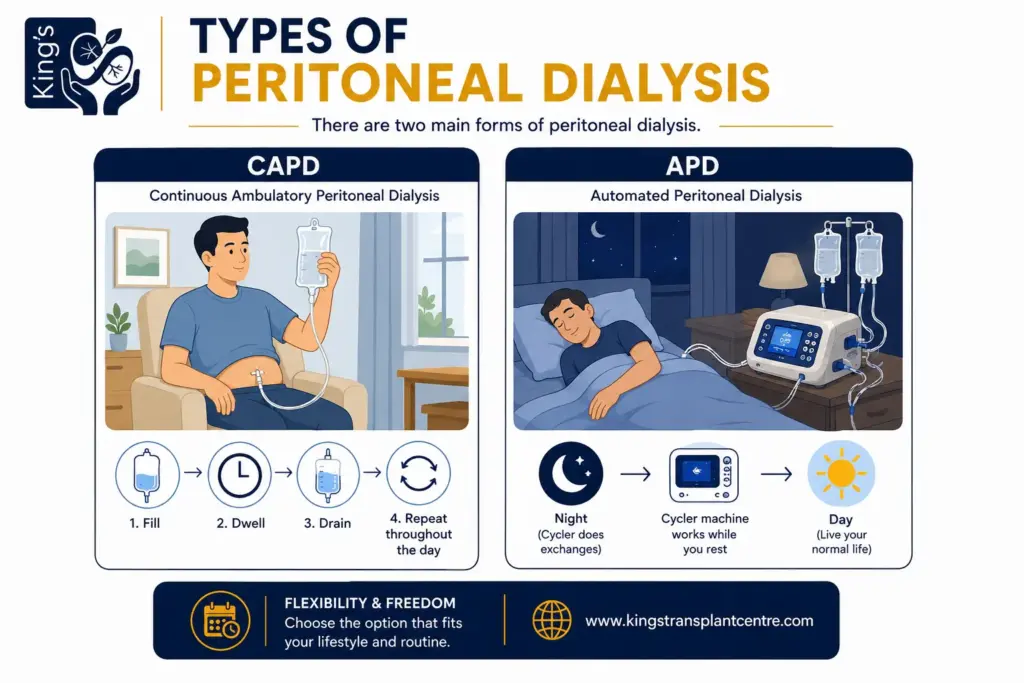
There are two main forms of peritoneal dialysis.
- Continuous Ambulatory Peritoneal Dialysis (CAPD)
CAPD is performed manually throughout the day. Patients complete several fluid exchanges without needing a machine, making it suitable for people who prefer a flexible daytime routine.
- Automated Peritoneal Dialysis (APD)
APD has a cycler machine for fluid exchanges during the night while the patient rests. This allows most of the day to be dedicated to work, school or family life.
Benefits of Peritoneal Dialysis
There are benefits of Peritoneal Dialysis. Peritoneal dialysis has advantages. Peritoneal dialysis is a choice for many patients because it provides:
- Greater flexibility
- Home-based treatment
- Fewer hospital visits
- Helps maintain a fluid balance that is more stable
- Greater independence
- Easier travel planning
- Often fewer dietary restrictions than with hemodialysis
For suitable patients, it can provide a treatment schedule that fits more naturally into daily life.
Challenges of Peritoneal Dialysis
Although there are benefits to this type of dialysis, it takes dedication.
Patients need to:
- Maintain excellent hygiene
- Sterilizing the catheter
- Home-dialyze supplies should be stored at home
- Take medications as directed on a daily basis
- Monitor for signs of peritonitis or catheter-related complications
Regular follow-up with the kidney care team remains essential throughout treatment.
Understanding the two main types of Dialysis
Both dialysis methods remove toxins from the blood, but they do so differently.
Hemodialysis | Peritoneal Dialysis |
Blood is filtered through a dialysis machine. | The lining of the abdomen acts as the natural filter. |
Usually performed at a dialysis center or at home. | Usually performed at home. |
Requires vascular access. | Requires a catheter placed into the abdomen. |
Usually three sessions each week. | Performed daily through scheduled exchanges. |
Healthcare professionals supervise most treatments. | Patients perform treatment independently after training. |
Hemodialysis vs Peritoneal Dialysis: Which treatment is right for you?
Choosing between Hemodialysis vs Peritoneal Dialysis is not simply a medical decision. It is also about finding a treatment that fits your health, lifestyle, work, family responsibilities, and long-term goals.
Your nephrologist will discuss several factors before recommending the most appropriate option, including:
- The stage and cause of your kidney disease
- Your age and overall health
- Heart and blood vessel health
- Previous abdominal surgeries
- Your home environment and support system
- Your ability to perform dialysis independently
- Your daily routine and travel needs
- Whether you are waiting for a kidney transplant
For some patients, home-based peritoneal dialysis offers greater flexibility. Others may feel more comfortable receiving hemodialysis under the supervision of experienced healthcare professionals.
There is no universally “better” dialysis treatment. The best choice is the one that safely meets your medical needs while allowing you to maintain the highest possible quality of life.
Is Dialysis painful?
One of the most common questions patients ask is, “Is dialysis painful?“
The treatment itself is generally not painful.
During hemodialysis, patients may feel a brief pinch when the needles are inserted into the fistula or graft. Once treatment begins, most people experience little or no pain. Some patients may notice muscle cramps, headaches, or tiredness toward the end of the session, but these symptoms are usually manageable.
In the typical course of PD, there are no needles involved. Occasionally, the first time the dialysis fluid is placed in the abdomen, the person feels a bit uncomfortable or feels full, especially during the first weeks. This typically gets better over time.
Your healthcare team continually monitors treatment and can make adjustments to improve comfort whenever needed.
Hemodialysis Catheter vs Peritoneal Dialysis Catheter
Although both catheters provide access for dialysis, they serve different purposes.
Hemodialysis Catheter | Peritoneal Dialysis Catheter |
Inserted into a large vein in the neck or chest | Inserted into the abdominal cavity |
Used to access the bloodstream | Used to deliver dialysis fluid into the abdomen |
Often temporary until permanent access is ready | Usually remains in place for long-term peritoneal dialysis |
Higher infection risk than a fistula | Requires daily exit-site care to reduce infection risk |
For patients receiving long-term hemodialysis, an arteriovenous fistula remains the preferred option because it has the lowest complication rate.
How long can you live on Dialysis?
A diagnosis of kidney failure does not mean life comes to a stop.
Many people ask, “How long can you live on dialysis?“
The answer varies from person to person.
Life expectancy depends on factors such as:
- Age
- Overall health
- Other medical conditions
- Cause of kidney failure
- How well dialysis is performed
- Nutritional status
- Adherence to medications
- Eligibility for kidney transplantation
Some patients remain on dialysis for many years or even decades while continuing to work, travel, and enjoy family life.
For eligible patients, kidney transplantation often offers improved long-term survival and a better quality of life compared with remaining on dialysis indefinitely.
Can Dialysis be temporary?
Yes. Although many people require dialysis for advanced chronic kidney disease, dialysis is not always permanent.
Temporary dialysis may be needed when kidney function is expected to recover, such as after:
- Severe dehydration
- Acute kidney injury
- Certain infections
- Major surgery
- Drug-related kidney injury
Once kidney function improves sufficiently, dialysis can often be discontinued.
Patients with permanent kidney failure usually require long-term dialysis unless they receive a kidney transplant.
Dialysis and Kidney Transplantation
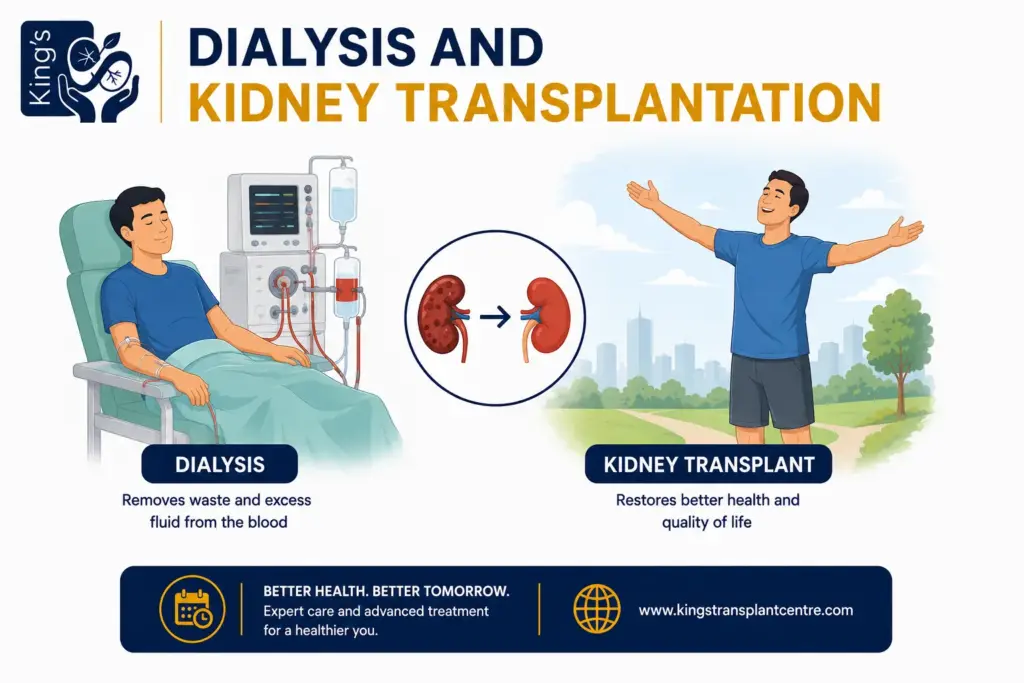
Dialysis replaces only part of the kidneys’ function. It removes waste and excess fluid but cannot completely restore normal kidney function.
For many patients with end-stage kidney disease, kidney transplantation offers the closest alternative to a healthy kidney.
A successful transplant can:
- Eliminate the need for long-term dialysis
- Improve energy levels
- Allow greater dietary freedom
- Improve quality of life
- Reduce long-term complications associated with kidney failure
Many patients begin dialysis while undergoing evaluation for transplantation. Careful planning ensures they remain healthy while waiting for a suitable donor.
Why choose King's Transplant Centre of Excellence?
Managing kidney failure requires far more than dialysis alone. Patients benefit most from a team that can provide diagnosis, dialysis, transplant evaluation, surgery, and lifelong follow-up in one place.
At King’s Transplant Centre of Excellence, patients receive coordinated care from internationally recognized specialists with expertise in complex kidney disease and transplantation.
Our strengths include:
- A comprehensive approach from diagnosis to long-term recovery.
- A multidisciplinary team of transplant surgeons, nephrologists, intensivists, specialist nurses, dietitians, physiotherapists, psychologists and transplant coordinators.
- Hemodialysis and peritoneal dialysis services tailored to each patient’s medical needs
- Expertise in both living donor and deceased donor kidney transplantation for adults and children
- More than 95% transplant success rate with excellent patient outcomes
- Affiliation with King’s College Hospital London and Rela Institute, India
- Advanced diagnostic imaging, interventional radiology, and renal intensive care under one roof
- Access to the latest evidence-based treatments, clinical research, and innovative transplant techniques
- Personalized treatment plans designed to support every stage of the kidney care journey
Whether you are newly diagnosed with chronic kidney disease or preparing for transplantation, our team works alongside you and your family to deliver compassionate, individualized care from your first consultation onward.
Looking beyond Dialysis toward better kidney health
Choosing between hemodialysis vs peritoneal dialysis is an important decision, but it does not have to be made alone.
Both treatments effectively replace essential kidney function and can help people with kidney failure live active, fulfilling lives. The right option depends on your health, lifestyle, treatment goals, and personal preferences.
We at King’s Transplant Centre of Excellence believe that clear guidance, advanced treatment options and continued support should be provided to all patients. We have a dedicated, highly trained multidisciplinary team that will help you to make informed decisions with confidence, either as a long term treatment or as a bridge to kidney transplantation.
If you or someone you know has been identified as having advanced kidney disease, please consult our specialists to explore and discuss the option of dialysis as well as if kidney transplantation would be a better choice for a healthier life.
FAQs
What does a fistula for dialysis look like?
A dialysis fistula is typically a thickened vein that raises off the forearm or upper arm. When mature, it can sometimes be felt vibrating because of the increased blood flow and may feel slightly bigger.
When is dialysis needed?
Dialysis is recommended when the kidneys no longer keep the waste and excess fluid out of the body and when patients experience symptoms like fatigue, swelling, difficulty breathing, high potassium or when the kidneys are very badly damaged.
How long can you live without dialysis?
If kidney failure is total, the chances of survival without dialysis depend on the level of kidney function and health of the individual. If dialysis or a kidney transplant are not performed, the waste products will build up and become life-threatening.
Is dialysis permanent?
Not always. Patients with chronic end stage kidney disease typically need to have dialysis regularly for their kidneys to continue functioning, or to have a kidney transplant. If there is an acute kidney injury, dialysis may only be a temporary solution.
When to start dialysis creatinine level?
We do not have a specific creatinine level at which dialysis should start. The doctors take into account the following aspects of kidney function: laboratory test values, clinical condition, electrolyte levels, signs, and symptoms of the illness, and fluid overload, instead of focusing on any single laboratory test.
Can dialysis be temporary?
Yes. If dialysis is needed for a short time only, because the kidneys are likely to recover following an acute illness, severe infection, surgery or some kinds of kidney damage, it may be temporary.
Does dialysis make you tired?
Patients may feel fatigued due to fluid removal at the end of hemodialysis and fluctuations in blood pressure. With proper dialysis scheduling, diet and management of anemia and other medical conditions, fatigue can often be better.
Overview

Safeguarding Your Kidney Health with the Right Dialysis Care with King's Transplant Centre
When kidney function declines, dialysis becomes an important part of protecting your health and maintaining your quality of life. Hemodialysis and peritoneal dialysis work in different ways, and each option comes with its own treatment schedule, benefits, and considerations. Understanding these differences can help you feel more confident about the path ahead.
At King’s Transplant Centre, our kidney specialists assess your condition, lifestyle, and long-term needs to help determine which dialysis approach may be appropriate for you. With personalised guidance and expert kidney care, you can make an informed decision about your treatment and plan the next step with greater confidence.
Your kidney care deserves the right approach. Speak with King’s Transplant Centre for personalised dialysis guidance.