

Liver Transplant Criteria: What Makes You Eligible?

Being told that you may need a liver transplant can leave you with more questions than answers. Am I eligible? Is my liver disease severe enough? Does my age matter? What if I have another health condition? And how long might I have to wait?
Understanding the liver transplant criteria and requirements can make the process easier to navigate. Eligibility is not usually determined by one test or a single number. A transplant team considers the severity of your liver disease, overall health, medical urgency, age, other conditions and whether you are likely to benefit from transplantation.
At King’s Transplant Centre in Dubai, liver transplant assessment involves a detailed evaluation to determine whether transplantation is appropriate and which type of transplant may be suitable. Understanding the liver transplant criteria and requirements can help patients and families know what to expect before undergoing liver transplant surgery.
When is a Liver Transplant considered?
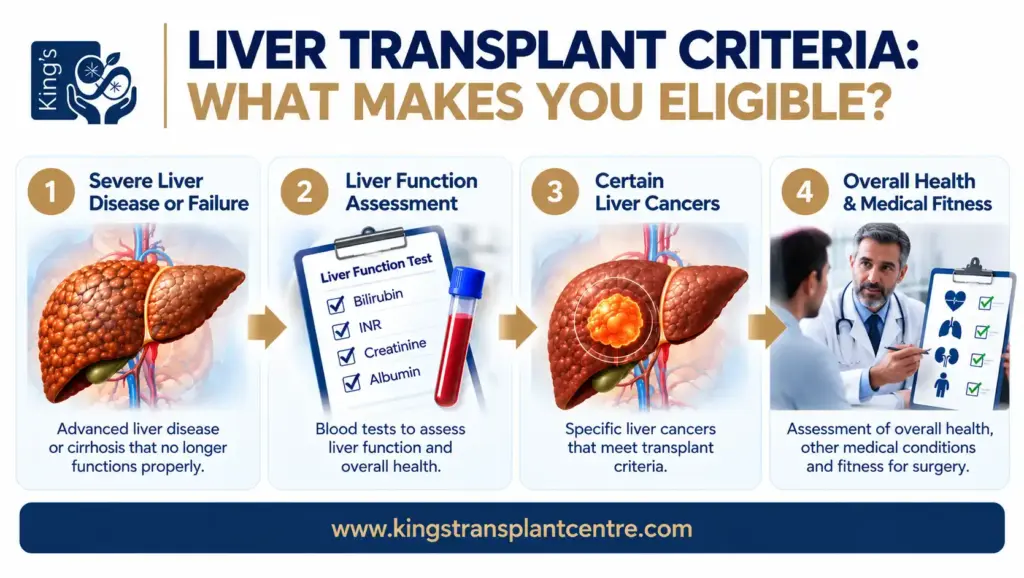
A liver transplant might be considered in cases where the liver has incurred irreversible or advanced damage and can no longer carry out its vital functions adequately. Conditions that may lead to consideration of transplantation include:
- End-stage liver disease or advanced cirrhosis
- Acute liver failure
- Certain liver cancers that meet transplant criteria
- Some genetic or metabolic liver diseases
- Other severe conditions resulting in irreversible liver failure
However, the need for a transplant is only the beginning of the assessment. The transplant team must determine whether transplantation is appropriate and whether the potential benefits outweigh the risks for that individual. These conditions form the basis of the liver transplant criteria used during assessment.
What is MELD score, and why does it matter?
If you are researching liver transplantation, you will probably come across the MELD score. The Model for End-Stage Liver Disease score is one of the tools used to assess the severity of liver disease. For many transplant candidates aged 12 and older, it also helps the medical team determine the level of urgency for transplantation. The current MELD calculation uses several clinical measurements, including bilirubin, INR, creatinine, sodium and albumin, along with other candidate information.
A higher MELD score generally indicates more severe liver disease and greater urgency for transplantation. However, there is no single MELD score that automatically makes someone eligible for a liver transplant.
The score is primarily a way of assessing medical urgency and helping with organ allocation. The transplant team still needs to consider your overall health, diagnosis, complications and whether transplantation is medically appropriate. Some candidates may also receive a MELD exception when their medical urgency is not adequately reflected by the standard score. This is one part of the broader liver transplant criteria used to determine eligibility.
What is the maximum age for Liver Transplant?
One of the most common questions patients ask is whether they are too old for a liver transplant. There is no universal maximum age for liver transplant that applies to every patient. Instead, transplant teams consider biological health and overall fitness alongside chronological age.
Your assessment may include:
- Heart and lung function
- Kidney function
- Physical fitness and frailty
- Other medical conditions
- Previous or current cancer
- Cognitive and psychological health
- Ability to recover from major surgery
- Ability to follow long-term treatment and follow-up
For this reason, two people of the same age may have very different transplant assessments. Age can be an important consideration, but it should not be treated as an automatic cut-off.
Who is not eligible for a Liver Transplant?
A liver transplant surgery is major surgery, so the transplant team needs to determine whether the expected benefits outweigh the risks. There is no single list that applies identically to every transplant program, but certain circumstances can make transplantation unsuitable or require further treatment before a patient can be reconsidered.
These may include:
- Certain advanced or metastatic cancers
- Uncontrolled infections
- Severe heart or lung disease
- Serious medical conditions that make major surgery excessively risky
- Active substance misuse
- Certain untreated psychological or psychiatric conditions that significantly affect the ability to participate in care
Severe frailty or other health problems may also affect candidacy. Importantly, being considered unsuitable at one stage does not necessarily mean that transplantation will never be possible. Some conditions can be treated or stabilized, after which the patient may be reassessed.
What is the evaluation process for a Liver Transplant?
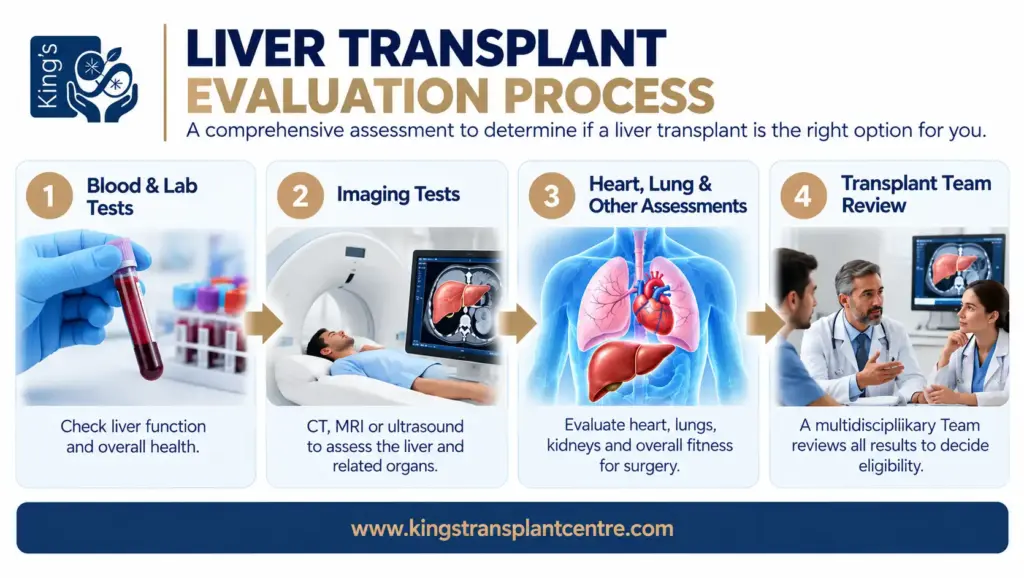
The evaluation process is central to the liver transplant criteria and a detailed assessment designed to determine whether transplantation is appropriate and whether you are medically prepared for major surgery. Depending on your circumstances, the evaluation may include:
- Medical history and examination
The transplant team reviews your liver disease, previous treatments, medications and other medical conditions.
- Blood tests
These may assess liver and kidney function, blood counts, clotting, infections and other factors relevant to transplantation.
- Imaging tests
Depending on your medical history, imaging tests may be carried out to evaluate the liver, blood vessels and nearby organs. These can include ultrasound, CT or MRI.
- Heart and lung assessment
Cardiac and pulmonary tests can help identify conditions that could increase the risks associated with transplantation.
- Cancer assessment
If liver cancer or another malignancy is involved, additional tests may be needed to determine whether transplantation is an appropriate option.
- Psychological and social assessment
The team may discuss emotional wellbeing, understanding of transplantation, support at home and your ability to manage ongoing medical care.
- Multidisciplinary review
The results are reviewed by the transplant team before a decision is made about candidacy.
The exact tests and specialists involved can vary according to your medical history and the transplant program.
What happens on the Liver Transplant waiting list?
If you are suitable for a deceased-donor liver transplant, you may be placed on the liver transplant waiting list. The time it takes to receive a suitable liver can vary, as allocation considers several medical and practical factors.
These may include:
- Medical urgency: Your liver disease severity and MELD score can help determine your priority for transplantation.
- Blood group: Donor and recipient blood groups are considered when assessing compatibility.
- Body size: The donor liver needs to be appropriately sized for the recipient.
- Donor availability: The number and type of suitable donor organs available can affect waiting times.
- Compatibility: Other donor and recipient characteristics may influence whether an organ is suitable.
- Changes in your health: Your condition is monitored while you wait, and your assessment may be updated if your health changes.
MELD and medical urgency help prioritize many adult candidates, but blood group, donor availability, compatibility and other factors also affect organ allocation. Therefore, there is no fixed waiting period, and our transplant team will monitor your health and explain what to expect.
What are the living donor criteria?
For some patients, a living donor can offer another transplant option. A suitable portion of the donor’s liver is transplanted into the recipient, and both the remaining and transplanted liver tissue can increase in size and function after surgery.
The living donor criteria are assessed separately from recipient eligibility. A potential donor undergoes detailed medical and psychological evaluation, which may include:
- Age and overall health
- Liver and kidney function
- Heart and lung health
- Body weight and physical condition
- Medical history
- Psychological wellbeing
- Understanding of the risks and recovery
- Ability to provide informed, voluntary consent
A donor does not have to be a family member. Depending on the transplant program, a suitable friend or unrelated donor may also be considered. Learn more about what living liver donation involves before considering this option. Donor safety remains central to the assessment.
Why choose King’s Transplant Centre for Liver Transplant care?
Liver transplantation involves much more than the liver transplant surgery itself. King’s Transplant Centre brings together specialist teams and transplant services to support patients through assessment, surgery, intensive care and long-term follow-up.
- Multidisciplinary transplant team: Care involves transplant surgeons, hepatologists, anaesthetists, intensivists, radiologists, specialist nurses, nutritionists and physiotherapists.
- Living and deceased donor transplantation: The centre offers liver transplant services using organs from both living donors and donors who have died.
- Adult and paediatric liver transplantation: Services are available for adults as well as children, including infants.
- Specialised transplant procedures: TThe centre offers living-donor, split-cadaveric and reduced-size liver transplant surgery where clinically appropriate.
- Comprehensive transplant pathway: Patients can receive assessment, donor evaluation, transplant surgery, intensive care, rehabilitation and post-transplant follow-up as part of their care journey.
- Support throughout recovery: Post-transplant monitoring and multidisciplinary follow-up help patients manage their health after transplantation.
Get the right guidance for your Liver Transplant journey with King’s Transplant Centre Dubai
Understanding the liver transplant criteria can help you make informed decisions about your care. Eligibility depends on several factors, including the severity of your liver disease, MELD score, overall health, age and ability to manage long-term treatment.
If you have been advised to consider a transplant, a specialist assessment can help determine whether you may be a suitable candidate and which options may be appropriate for you. Book an appointment with the transplant team at King’s Transplant Centre to discuss your liver transplant eligibility and next steps.
FAQs
The cost varies based on the transplant centre, hospital care, medications, complications and follow-up. Insurance coverage can also affect your out-of-pocket expenses, so your transplant centre can provide an estimate based on your circumstances.
There is no single MELD score that guarantees suitability for transplantation. The score helps assess medical urgency for many candidates, but transplant eligibility depends on the wider liver transplant criteria and clinical assessment.
Many people return to their usual activities after recovery. Lifelong follow-up, regular monitoring and anti-rejection medication remain necessary, while recovery and long-term outcomes vary between individuals.
Certain advanced cancers, uncontrolled infections, severe heart or lung disease, active substance misuse and other serious conditions may affect eligibility. Some issues can be treated or stabilized before reassessment.
There is no fixed waiting period. Medical urgency, blood group, donor availability, body size and other allocation factors can influence how long a patient waits. MELD contributes to medical prioritisation for many adult candidates, but is not the sole factor.
A medically suitable family member may be able to donate part of their liver after a thorough assessment. Being related does not automatically make someone eligible. Depending on the transplant program, an unrelated donor may also be considered.
Pre-transplant assessment may include blood and liver and kidney function tests, imaging, infection screening, heart and lung tests, cancer assessment and psychological and social evaluation. The exact investigations depend on the patient’s health and the transplant program.
Requirements typically include a confirmed diagnosis of advanced liver disease, a detailed medical evaluation, and assessment of overall health, MELD score, age-related fitness and psychological readiness. The transplant team reviews these factors together to determine suitability.
Overview
Understanding Liver Transplant Criteria at King's Transplant Centre
A liver transplant may be recommended when the liver becomes severely damaged and can no longer perform its essential functions effectively. Advanced cirrhosis, liver failure, certain liver cancers, and other serious liver conditions may make transplantation a consideration. Doctors also assess liver function, overall health, and the patient’s ability to undergo surgery and follow long-term post-transplant care.
At King’s Transplant Centre, our multidisciplinary transplant specialists conduct comprehensive medical evaluations using advanced diagnostic tests, imaging, and clinical assessments to determine whether liver transplantation is appropriate for each patient.
Your liver health matters. Schedule your consultation with King’s Transplant Centre for expert evaluation, personalised guidance, and access to advanced liver transplant care.