

What Causes High Liver Enzymes? The Silent Warning Hidden in Your Blood Test

You go for a routine check-up. A few days later, your GP calls to say your liver enzymes came back a little high. There’s no pain. No obvious symptoms. Just a number on a report that suddenly feels important.
This is more common than most people think, and it’s usually the first clue that something needs a closer look.
So, what causes high liver enzymes? There’s rarely just one answer. Sometimes it’s as simple as a recent course of antibiotics. Other times, it’s something that’s been building quietly for years without any signs at all.
At King’s Transplant Centre, our hepatology team see this scenario often: a patient referred with an unexplained result, wanting a straight answer about what it means.
What does elevated liver enzymes mean?
Think of your liver as your body’s quiet workhorse. It filters what you eat and drink, breaks down medications, and produces enzymes to keep all of this running smoothly.
The four enzymes doctors check most closely are ALT, AST, ALP, and GGT.
When liver cells become inflamed, damaged, or simply overworked, these enzymes leak into the bloodstream in larger amounts than usual.
An elevated liver enzymes causes result doesn’t tell you exactly what’s wrong. It tells you the liver is under some kind of strain, and that’s reason enough to look further.
A quick look at your liver panel
Enzyme | Typical adult range | What a high result often points to |
ALT | 7-56 U/L | Liver cell damage (the most liver-specific marker) |
AST | 10-40 U/L | Liver or muscle injury |
ALP | 44-147 U/L | Bile duct blockage, or occasionally bone-related issues |
GGT | 9-48 U/L | Bile duct problems, alcohol use, or fatty liver |
A few things worth knowing when you’re reading your own report:
- Reference ranges vary slightly from lab to lab, so it’s best to check the range printed on your specific test.
- Doctors read these numbers as a pattern, not in isolation.
- An AST-to-ALT ratio above 2 often points toward alcohol-related liver disease.
- When ALP and GGT rise together, without much change in ALT or AST, it usually points to the bile ducts rather than the liver cells themselves.
What causes high liver enzymes?
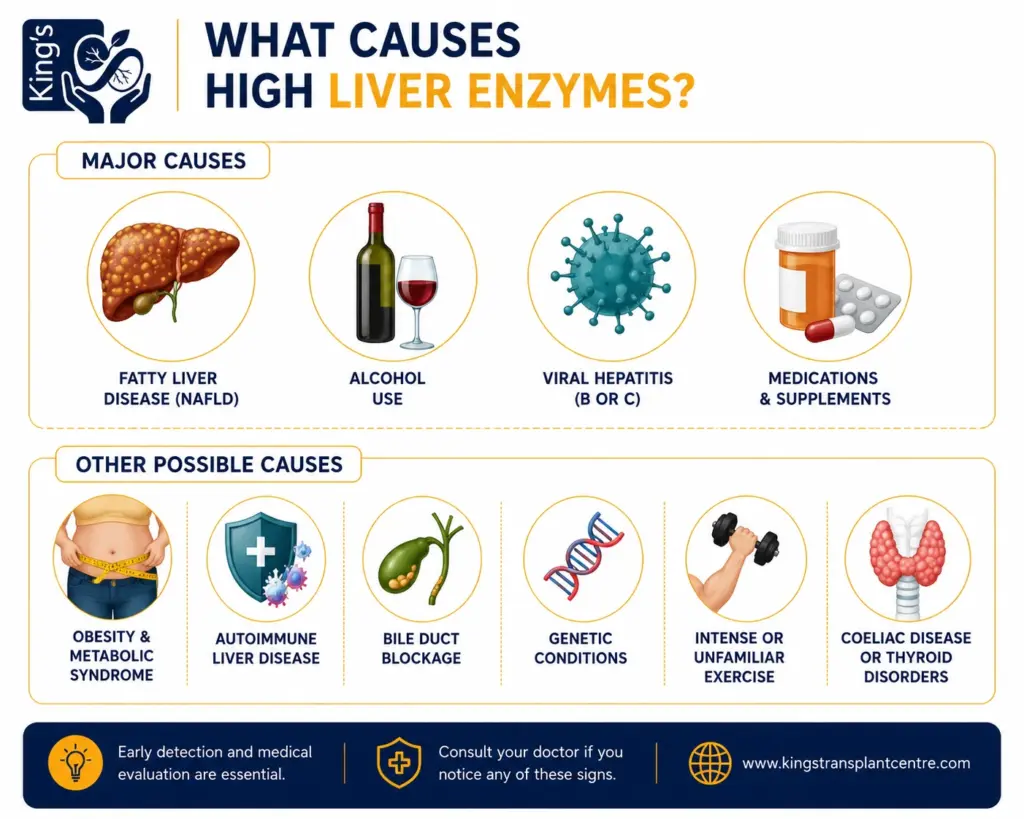
Elevated liver enzymes causes tend to fall into a handful of recognisable categories, and most patients fit fairly neatly into one of them.
Fatty liver disease (NAFLD): It’s closely tied to obesity, insulin resistance, and type 2 diabetes, and it’s thought to affect close to a quarter of US adults, many of whom have no idea until a blood test flags it.
Alcohol use: This isn’t just about heavy drinking. Regular, moderate alcohol intake can raise enzymes gradually over time, often without anyone noticing until levels are already elevated.
Viral hepatitis (Hepatitis B or C): It tends to be silent for a long time, and most people only find out through screening rather than anything they’ve actually felt or noticed.
Medications and supplements: Certain antibiotics, statins, anti-seizure medications, and paracetamol taken in excess can all raise liver enzymes. Herbal remedies and bodybuilding supplements are surprisingly frequent contributors to the picture and more often than not, patients don’t think to mention them unless they’re asked directly.
A few other causes worth being aware of:
- Obesity and metabolic syndrome, where excess abdominal fat drives ongoing liver inflammation
- Autoimmune liver disease, including autoimmune hepatitis and primary biliary cholangitis, more common in women
- Bile duct blockage caused by gallstones or scarring
Also Read :- Which Size of Gallbladder Stone Is Dangerous?
- Genetic conditions such as haemochromatosis (iron overload) and Wilson’s disease (copper overload), both of which run in families
- Intense or unfamiliar exercise, which can temporarily raise AST since it’s also found in muscle
- Coeliac disease or thyroid disorders, less common causes that are easy to overlook
For context, the American College of Physicians has noted that around 1 in 10 US adults shows some degree of unexplained liver enzyme elevation on routine testing, with fatty liver disease responsible for a large share of that figure.
Who's more likely to be affected?
Some patients simply carry more risk than others. It’s worth knowing where you stand.
- Carrying extra weight, particularly around the abdomen
- Type 2 diabetes or pre-diabetes
- Regular alcohol consumption
- High cholesterol or triglycerides
- A family history of liver disease
- Long-term medication use without regular monitoring
- Past exposure to hepatitis B or C
Symptoms of high liver enzymes
Here’s the part that catches people off guard. Symptoms of high liver enzymes are often completely absent in the early stages, which is exactly why this is called a silent issue.
When symptoms do show up, they’re usually vague enough to be mistaken for tiredness or a passing stomach bug.
Severity | What you might notice | Typical enzyme pattern |
Mild | Often nothing at all; occasional tiredness | ALT/AST slightly above normal |
Moderate | Fatigue, mild discomfort under the right ribs, nausea | ALT/AST 2-5 times normal |
Marked | Poor appetite, dark urine, yellowing of skin or eyes, itching | ALT/AST/ALP clearly raised |
Advanced | Abdominal or leg swelling, easy bruising, confusion | Enzymes plus abnormal bilirubin, albumin, or clotting |
What happens when your liver enzymes are high?
what happens when your liver enzymes are high and how long they stay that way.
A single mild rise, especially one linked to a short course of medication or a particularly indulgent weekend, often settles on its own once that trigger has passed.
But enzymes that remain high, or keep climbing on repeat testing, usually point to ongoing liver injury that shouldn’t be left unchecked. Over time, this can progress through recognisable stages:
- Fatty change
- Inflammation
- Fibrosis (scarring)
- Cirrhosis
Liver cirrhosis brings its own set of complications, including fluid build-up in the abdomen, internal bleeding from enlarged veins, and a gradual decline in liver function that can, in more advanced cases, call for specialist care or transplant evaluation.
Can high liver enzymes cause death?
It’s a fair question, and it deserves a straightforward answer: not directly, no.
The enzyme numbers themselves aren’t what’s dangerous. What matters is the condition causing them.
Advanced cirrhosis, acute liver failure, and fulminant hepatitis can all turn life-threatening if left without treatment for too long. But that’s genuinely not where most people end up. Caught early, most causes are manageable, and many are fully reversible.
How are elevated liver enzymes diagnosed?
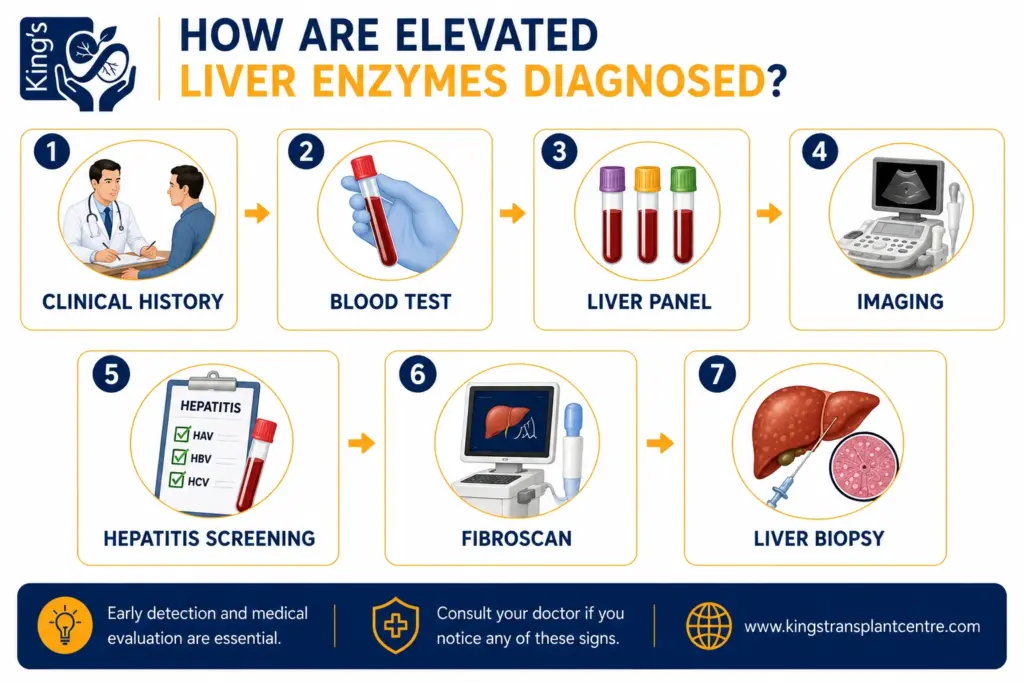
The work-up usually starts simply and becomes more targeted as findings come in.
- Clinical history – alcohol use, current medications, supplements, and family history
- Repeat blood test – to rule out a lab error or a temporary spike
- Extended liver panel – bilirubin, albumin, and clotting studies for a fuller picture
- Imaging – usually an ultrasound first, followed by CT or MRI if needed
- Viral hepatitis screening, along with autoimmune or genetic marker testing where relevant
- Fibrosis testing – non-invasive tools like FibroScan can check for scarring without a biopsy
- Liver biopsy – reserved for cases where the cause remains unclear, or fibrosis needs precise staging
When to see a doctor without waiting?
Some symptoms shouldn’t be left until a routine follow-up. If any of the following show up alongside a known or suspected liver enzyme issue, it’s worth getting seen sooner rather than later:
- Yellowing of the skin or eyes
- Persistent nausea, vomiting, or loss of appetite
- Dark urine or unusually pale stools
- Swelling in the abdomen or legs
- Itching that won’t settle
- Confusion, drowsiness, or unexplained bruising
Treatment: It's about the cause, not the number
There’s no single treatment for “high liver enzymes,” because it isn’t really a condition on its own. Management always targets whatever is driving the elevation.
Fatty liver disease: Weight loss makes the biggest difference here, and it doesn’t take a dramatic amount either. Losing even 7-10% of body weight can meaningfully reduce liver fat. Making small changes to your diet and staying active can go a long way. Try cutting back on added sugar and saturated fat while getting regular exercise.
Alcohol-related elevation: Reducing or stopping intake often brings enzymes back to normal within weeks, sometimes faster than people expect.
Viral hepatitis: Antiviral treatments have come a long way, specific options are now available that can clear or effectively manage the infection in most patients.
Medication-induced elevation: This typically clears up once the causative drug is adjusted or discontinued, always under the supervision of a doctor.
Autoimmune or genetic causes: Autoimmune hepatitis is typically managed with immunomodulating medication. Haemochromatosis is treated with regular blood removal (phlebotomy) to bring iron levels down.
Practical habits worth building in
- Review every medication and supplement you’re taking with your doctor
- Cut back on alcohol, or stop entirely if that’s what’s advised
- Aim for gradual, steady weight loss rather than a crash diet
- Keep blood sugar and cholesterol within target ranges
- Stay current on hepatitis vaccination if recommended for you
- Don’t skip follow-up bloodwork just because you feel fine
- Avoid mixing alcohol with paracetamol or other liver-processed medications
Prevention: Small habits that add up
- Maintain a healthy weight through a consistent diet and movement, rather than short-term fixes
- Try to stay within recommended alcohol limits, and if you already carry risk factors, avoiding alcohol altogether is the safer choice.
- Get screened for hepatitis B and C if you have any known exposure risk
- Have periodic bloodwork done if you’re managing diabetes, obesity, or have a family history of liver disease
- Check with a pharmacist or doctor before starting any new supplement, especially those marketed for weight loss or muscle gain
Don't ignore what the blood test is telling you
An elevated result isn’t a diagnosis on its own. But it isn’t something to brush off either.
Understanding what causes high liver enzymes takes the guesswork out of a finding that can otherwise feel worrying. Most causes are identifiable. Most are manageable. Many are fully reversible once you know what you’re dealing with.
If your bloodwork has shown something similar, at King’s Transplant Centre, you get a clear diagnosis and a practical plan forward, rather than leaving you to sit with an unexplained number.
FAQs
What cancers cause elevated liver enzymes?
Primary liver cancer (hepatocellular carcinoma) and cancers that spread to the liver from the colon, pancreas, or breast can raise liver enzymes, particularly ALP and GGT when bile ducts are affected.
What does elevated liver enzymes mean?
Elevated liver enzymes don’t automatically mean you have liver disease. They simply suggest that your liver may be under stress or inflamed, and your healthcare provider may recommend more tests to find out why.
Can stress cause elevated liver enzymes?
No. But chronic stress can have indirect impact on liver health leading to unhealthy habits like poor sleep, weight gain, drinking more alcohol, and hormonal changes.
What are the reasons for elevated liver enzymes?
Elevated liver enzymes can have a number of causes, but fatty liver disease, alcohol use, viral hepatitis, certain medications, and obesity are the most common. Less common causes include autoimmune and inherited liver diseases.
What happens when your liver enzymes are high?
A mild, short-term rise often settles once the trigger is addressed. Levels which are continuously elevating need proper medical evaluation to prevent long-term liver damage.
Overview
Advanced Diagnosis and Care for High Liver Enzymes at King's Transplant Centre
High liver enzyme levels often do not cause noticeable symptoms, but they can be an early sign that your liver is under stress. what causes high liver enzymes include fatty liver disease, viral hepatitis, alcohol-related liver damage, certain medications, metabolic conditions, and other liver disorders. Identifying the underlying cause through timely evaluation can help prevent complications and support better long-term liver health.
At King’s Transplant Centre, our experienced liver specialists use advanced diagnostic tests, detailed clinical assessments, and personalised treatment plans to determine why your liver enzyme levels are elevated and recommend the most appropriate course of care.
Don’t ignore abnormal liver test results. Schedule your consultation today for an accurate diagnosis, expert guidance, and comprehensive liver care tailored to your needs.